

Hello. It's November 11.
Longevity supplements love big promises and tiny studies. This week, one of them faced a placebo-controlled trial on blood vessel health. The results are real. So are the caveats.
The rundown:
US health officials just opened a legal lane for six popular peptides - and a longevity brand is already lining up to sell them
A study of 830,000 people challenges a common dementia fear about overactive-bladder drugs
Why two biological age tests can give you two different answers
A lab-grown blood vessel is heading into its first heart-bypass trial
Let's get to it. 👇


Aging clocks often disagree with each other - a new review in Aging found that "aging clocks" (tests that estimate how old your body really is) don't always agree: a two-year calorie-cutting trial slowed one clock but not several others. Neither of the big trials showed people actually lived longer. Earth.com
Women with a longer reproductive lifespan showed healthier blood vessels in the brain - in 352 Swedish women scanned at age 70, using birth control pills or menopausal hormone therapy was also linked to fewer signs of small-vessel damage. It's an association, not proof that either protects the brain. EurekAlert
Insilico Medicine open-sourced Longevity Grok, an AI built with David Sinclair that pulls your labs, wearable data and health records into one view - the code is public (that's what open-source means) and the company says privacy is the default. PR Newswire
Viome acquired Sōlaria Biō to launch consumer "synbiotics" and medical foods - synbiotics pair probiotics with the fibers that feed them. Longevity.Technology
Humacyte is starting the first human trial of a lab-grown blood vessel for heart bypass surgery - 10 patients will get an off-the-shelf vessel grown from banked human cells, instead of one harvested from their own body. BiopharmaWatch

FROM THE CLINIC
A Longevity Supplement Just Got a Real Placebo Trial
Most longevity supplements are sold on mouse studies and good vibes. This one got a placebo-controlled human trial.
The product is NOVOS Core, a 12-ingredient daily supplement. In the STAMINA trial, published November 4 in European Heart Journal Open, 61 healthy adults aged 40 and over took either the supplement or a lookalike dummy pill (a placebo) for six months. It was double-blind, meaning neither the participants nor the researchers knew who got which.
What it found:
Blood vessel function (how well the lining of your arteries relaxes and widens) beat placebo by 2.9 percentage points. It's measured by seeing how much an arm artery widens after a blood-pressure cuff is released.
Arteries became more flexible, and systolic blood pressure (the top number) came in 6.1 points lower than placebo.
Cholesterol and other blood fats didn't change.
The catch: NOVOS made the product and helped fund the study. Only 43 people made it into the main analysis, and most dropouts were unexplained. The trial tracked markers, not heart attacks or lifespan, and nobody knows which of the 12 ingredients did the work.
Why it matters: it clears a higher bar than most supplements ever try to - placebo, six months, peer review. But "improved a blood vessel marker" is not the same as "slowed aging." If you take supplements, that's your checklist: human trial, placebo, independent replication.

UP YOUR LONGEVITY GAME

The Long Game - with Dr. Thomas Lewis
Every civilization has had to make peace with growing old. Ours may be the first that doesn't. The Long Game is the story of how we got here, what's happening now, and where we are headed.
Producers of the longevity documentary Forever Young spent many hours filming and interviewing the world's top longevity scientists - the founders of the field.
They turned it into The Long Game - a 21-chapter deep dive into the science of longevity, featuring contributions from scientists you don't normally get in the same room: Dr. Eric Verdin, Dr. Nir Barzilai, Dr. Richard Miller, Dr. Steve Horvath and Dr. Thomas Lewis.
This is not a summary course. This is exclusive access to the people doing the scientific breakthrough work. Twenty-one chapters that build the foundation to evaluate longevity science yourself.
👉 Get 15% OFF The Long Game with code LONGEVITY

LONGEVITY BIZ
The US Just Opened a Door for Six Peptides

Peptides - short chains of amino acids that act as signals in the body - are one of the hottest corners of the biohacking market, and they just got a regulatory nudge. Under an interim policy announced in late October, US health officials say they won't go after licensed pharmacies and doctors who compound (custom-make) six of them: BPC-157, Epitalon, KPV, MOTS-c, Semax and TB-500.
Longevity brand Elysium Health moved first. It says it will offer all six through its prescription arm by year-end and is launching a peptide research program. The fine print: this isn't FDA approval, it's temporary, every product still needs a doctor's prescription, and Elysium itself says human evidence for these peptides is limited.
The stated goal: steer people away from "research-use-only" peptides from foreign manufacturers and toward a more controlled supply.
IN THE NEWS
The Overactive Bladder Drug and Dementia Fear Gets a Second Look

Overactive bladder (OAB) gets more common with age. Older OAB drugs called anticholinergics (they block a chemical messenger called acetylcholine) have carried dementia worries for years, so doctors often prefer newer ones called beta-3 agonists.
A JAMA Network Open study of 830,393 adults aged 40 to 90, published November 6, found the newer drugs weren't linked to lower dementia risk. Estimated 10-year risk was about 20% on the newer drugs versus roughly 18 to 19% on the older ones.
Don't read that as "the old drugs are safe." It's based on health records, not a trial, earlier studies linked the older drugs to higher dementia risk, and geriatric guidelines still say older adults should generally avoid strongly anticholinergic drugs. The authors want it replicated. Taking bladder medication? Talk to your doctor before changing anything.

CHECK YOUR STACK
Know Your Biomarkers
Biological age tests can disagree with each other. A broad blood panel gives you a steadier baseline to track over time. Superpower tests 100+ biomarkers in a single panel, at 2,000+ US labs or with a home visit. $199/year, HSA and FSA eligible. Use code STAYIN20OFF to save $20 on your first purchase.
BIOHACK BOOKS
Spoon-Fed: Why Almost Everything We've Been Told About Food Is Wrong
Tim Spector
This week's FROM THE CLINIC showed how hard it is to prove that a supplement works. Spector, a King's College London epidemiology professor, makes the same point about food: far less of what we're told to eat is backed by good evidence than you'd think. Short, myth-busting chapters and a healthy habit of asking where the data is.

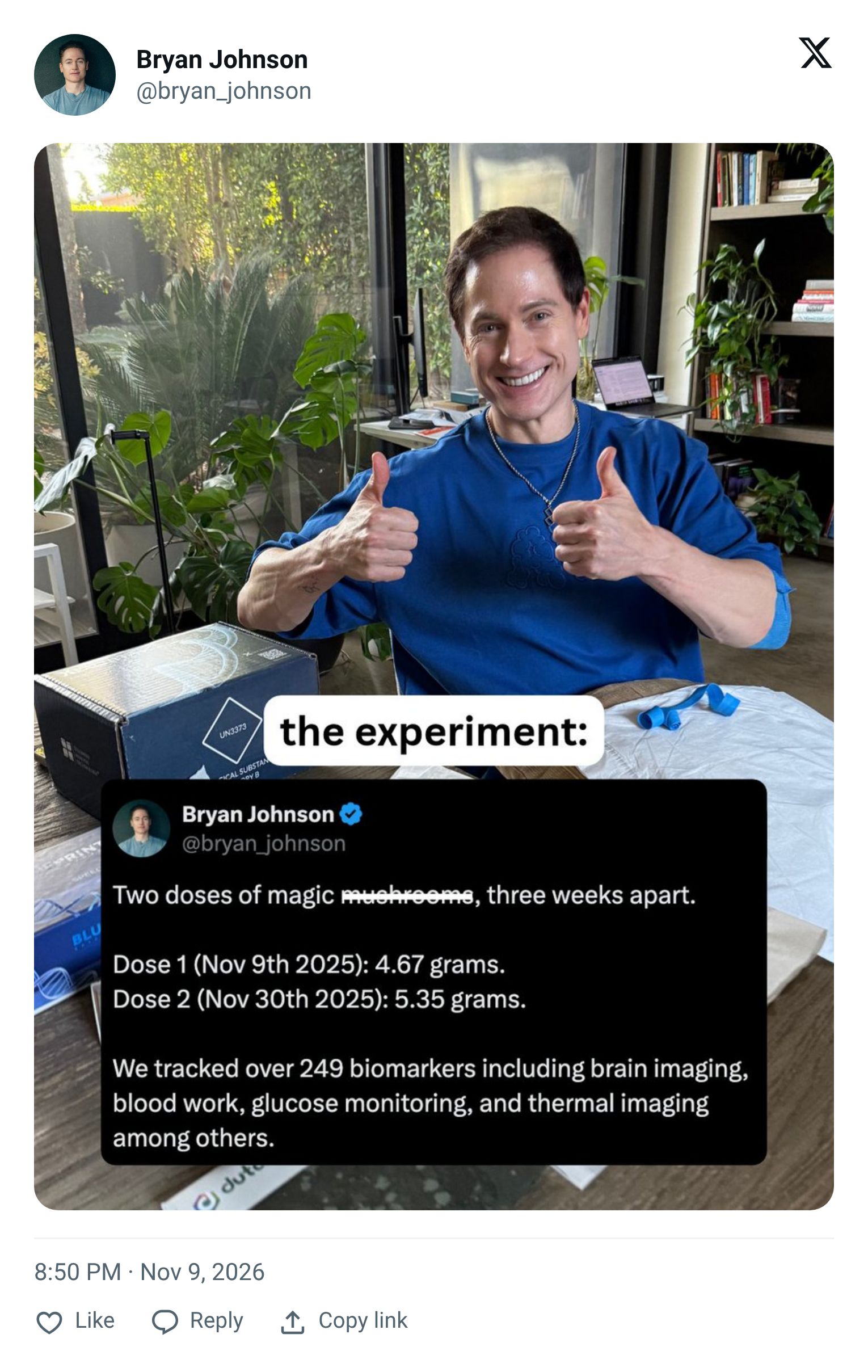
The most measured mushroom trip of the world 👇
Affiliate disclaimer: This newsletter may contain affiliate links that earn us a commission upon sale at no extra cost to you. This helps support the newsletter.
Medical Disclaimer: This newsletter is for informational purposes only and does not constitute medical advice. Always consult a qualified healthcare professional before making changes to your health protocol. Content may contain errors, may become outdated, and we are not responsible for information provided by third-party sources. Any action taken based on this content is strictly at your own risk.
